The Canary Islands will suspend classes in Gran Canaria during the visit of Pope Leo XIV.
The Government of the Canary Islands will also recommend remote working in Las Palmas and will implement an extensive security and healthcare operation.
The GC-1 motorway will be closed for four and a half hours, with traffic restrictions in place for a total of nine hours on different sections during the Pope’s visit to Gran Canaria.
On Thursday the 11th, the southbound carriageway between kilometres 15 and 56, from Gando Airport to Arguineguín, will close from 10:30 to 11:45. The same section will close northbound from 12:15 to 13:15, continuing to kilometre 0 at the entrance to Las Palmas de Gran Canaria. In addition, all exit ramps to the GC-500 in both directions will remain closed from 9:30 to 14:00.
Preparations are also being finalised at the Port of Arguineguín for the “Stage of Hope”, which has been approved by the Vatican.
A Vatican delegation is supervising the final preparations at the Port of Arguineguín, where the stage and security arrangements are being completed ahead of an event centred on migration, welcome, and hope.

Mogán Municipal Ordinance on the Use and Enjoyment of Beaches.
The Mogán Local Police have launched special surveillance operations along the municipality’s coastline in anticipation of summer, with the aim of promoting responsible beach use. Last week, officers issued over one hundred citations, 62 of which were for smoking or discarding cigarette butts on the sand—practices expressly prohibited by the Mogán Municipal Ordinance on the Use and Enjoyment of Beaches.
The operation, carried out by plainclothes officers, patrolled the entire coastline, inspecting various beaches to detect and penalize violations of current regulations. Among the most common infractions were smoking on the beach and discarding cigarette butts (resulting in citations), drug use and possession (resulting in nearly twenty citations), unauthorized street vending, and illegal gambling.
The established penalties are up to €450 for smoking, up to €1,800 for littering cigarette butts, and up to €900 for illegal gambling and street vending, in addition to the confiscation of the merchandise. In the case of drug use, the infraction is regulated by the Municipal Ordinance on Coexistence and Citizen Security, with a fine ranging from €751 to €1,500.

Tourist spending in Gran Canaria grows by 6.17% and exceeds €2 billion at the start of 2026.
The island maintains its revenue growth despite a slight increase in visitors and a reduction in length of stay.
Tourism in Gran Canaria generated €2,003.7 million in the first quarter of 2016, a 6.17% increase compared to the same period of the previous year.
This growth is accompanied by a moderate increase in visitors, of 1%, confirming that the sector is gaining revenue per tourist rather than from overall volume.
The average expenditure per stay was €1,620.75, and daily spending reached €183.93, according to ISTAC data.
By market, Germany led the growth in spending, followed by the Netherlands, while the Nordic countries remain the main source of tourists in terms of total spending.
The United Kingdom experienced more moderate growth, and domestic spending decreased during this period.

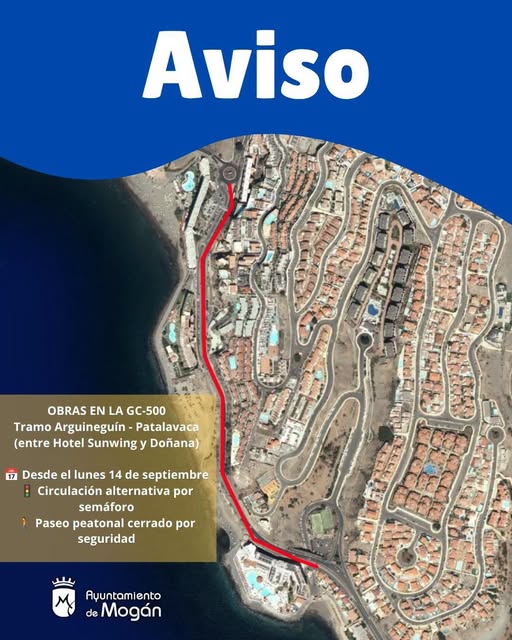
The road between Arguineguín and Patalavaca will close for 15 days
The road between Arguineguín and Patalavaca will close for 15 days due to works on the slopes affected by Storm Therese. The cuts on the GC-500 will be from Monday to Friday between 9:00 a.m. and 4:00 p.m. and traffic will be diverted along the GC-1
The restrictions will affect the section between the whale tail roundabout, in Arguineguín, and the spiral roundabout, in Patalavaca.
The Cabildo indicates that the works will consist of cleaning up the slopes through the controlled collapse of stones at risk of falling and the subsequent reinforcement of the slopes with shotcrete.
The actions are part of the emergency work carried out after the damage caused by Storm Therese to the Gran Canaria road network.
Pope’s visit to Gran Canaria, key information for tourists in Maspalomas and Arguineguín
How to attend the Pope’s visit to Gran Canaria, key information for tourists in Maspalomas and Arguineguín
Pope Leo XIV will mark a turning point in the history of the archipelago with his visit to Gran Canaria on June 11, 2026. For the thousands of visitors staying in the southern tourist resorts of the island, such as Maspalomas and Arguineguin the main event will be a large-scale mass at sunset on Thursday, June 11, at the Gran Canaria Stadium. This event, which concludes his tour of Spain, has generated unprecedented anticipation, requiring meticulous logistical planning.
Attendance at the liturgical services requires mandatory registration through the official papal visit platform. Tourists must obtain their digital pass in advance, indicating whether they are attending individually or in family groups. Authorities have already warned that demand will far exceed the venue’s capacity, so registration will close as soon as the safe capacity is reached. Those who cannot get a ticket to the stadium will have the option of following the “Popemobile” route through the main arteries of the capital.
Ordinary Owners Meeting for La Canaria Community
Local news 23-03-2026
Maspalomas 24h
https://maspalomas24h.de/art/10045/el-tribunal-supremo-decidira-si-la-pandemia-permite-bajar-el-canon-de-los-hoteles-en-la-costa-de-mogan
23 of March 2026
The Supreme Court will decide whether the pandemic allows for a reduction in the hotel fee on the Mogán coast.
The hotel sector in southern Gran Canaria has managed to create a legal loophole with unforeseen consequences. The Supreme Court, as Maspalomas24H has confirmed, has accepted for review the appeal filed by La Canaria Hotel Operation, owned by Nordic businessman Lars Wenaas and linked to the Radisson Blue Resort complex in Patalavaca (Mogán). The appeal seeks to determine whether the COVID-19 crisis can be legally considered a case of force majeure that would compel the administration to reduce or waive the fee for occupying the public maritime-terrestrial domain.
If the ruling is in favor of the company, it would open the door for numerous concessionaires in southern Gran Canaria to claim refunds for the fees paid during the Great Bull Run, which would provide millions of euros in financial relief for the tourism sector in Mogán and San Bartolomé de Tirajana.
The conflict arose after the Canary Islands Coastal Authority refused to grant extraordinary economic measures to the company, which requested total exemption or a reduction of more than 80% of its fees for the years 2020 and 2021. Until now, the High Court of Justice of the Canary Islands (TSJC) had aligned itself with the state’s position, arguing that the Coastal Regulations limit “force majeure” to physical or natural events such as earthquakes, tsunamis or fires, leaving out epidemiological crises.
However, the Supreme Court considers that there is a clear legal interest in the case, as there is no specific case law clarifying whether a pandemic justifies the modification of a coastal concession. The ruling will be of paramount importance for the Canary Islands coastline: if the Supreme Court rules in favor of the Mogán hotel, it will set a precedent allowing hundreds of beaches and hotel concession holders to claim refunds of millions of euros paid during the months of the tourism shutdown.
The final decision now rests with the Fifth Section of the Administrative Court. The legal debate will focus on interpreting whether the “exceptional cause” mentioned in the Coastal Law is flexible enough to justify the hotel closures caused by the virus, an interpretation that the State categorically rejects but which the Supreme Court deems necessary to clarify for the entire country.
The key to the TSJC’s initial ruling, now under appeal, was a restrictive interpretation of the Coastal Regulations:
Article 162.2 of the Regulation limits “force majeure” to physical events such as coastal erosion, earthquakes, tsunamis, storms, or fires. The Canary Islands court considered that the health crisis did not fall under these categories, since the regulation refers to “physical or natural phenomena that affect public property.”
The Supreme Court has decided to intervene because there is no prior case law on whether a pandemic allows for the modification of this type of concession. The justices deem it necessary to clarify whether the concept of “force majeure” included in the Coastal Law is applicable to a global epidemiological crisis. The High Court must determine whether COVID-19 is an “exceptional cause” that justifies altering the economic conditions of hotels on the coast.
Ordinary Owners Meeting for La Canaria Community 2026
Ordinary Owners Meeting for La Canaria Community
7 of May 2026 at 10 am
Place: Conference room 1st floor La Canaria